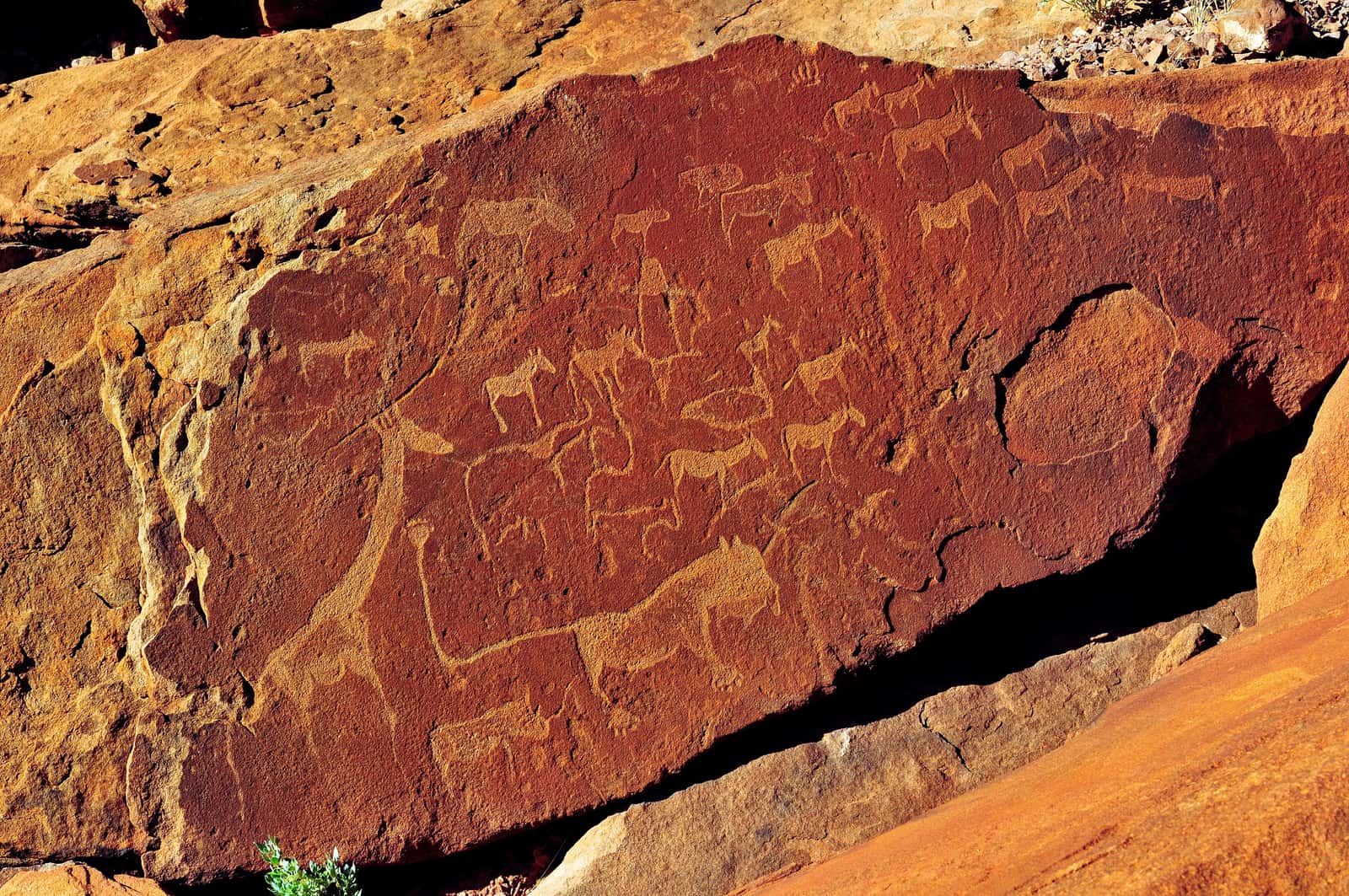
Twyfelfontein lies in a side valley in Damaraland, about 100 kilometres west of Khorixas. Sandstone slabs litter the slopes, and hunter-gatherers and later herders pecked animals, tracks and signs into them. UNESCO listed the site as World Heritage in 2007, the first in Namibia. It had already been a national monument since 1952, after visitors carried off engraved stones.
- engravings on 212 slabs, counted in 1950
- over 2,500
- UNESCO World Heritage Site
- 2007
- national monument
- 1952
- access to the rock art
- guide only
A count in 1950 found over 2,500 engravings on 212 slabs. Today the estimate is more than 5,000 images. Most were made by hunter-gatherers of the Wilton culture, while the geometric and later images are attributed to Khoikhoi herders. Estimates of their age vary widely. The British Museum dates the styles to between 6,000 and 1,000 years ago. Other estimates put the oldest engravings at up to 10,000 years.
You cannot walk to the slabs alone. At the visitor centre you wait for a guide, who takes you along a path on the slope; the guide is included in the fee. The visitor centre and the campsite are run jointly by the lodge owners and the Twyfelfontein-Uibasen Conservancy, in other words with the people who live here.

The best-known slab is the Lion Plate. Instead of paws the lion has spoor, as if the engraver wanted to show what you see of a lion first: its tracks. Not far away is the Dancing Kudu, only about 20 centimetres tall. And a rock hollowed out by the wind is called the Lion's Mouth. Since 2017 researchers have found thousands more rock images at at least 200 further sites to the west along the Huab.
The valley owes its name to a farmer. The Damara called the spring ǀUi-ǁaes, the leaping spring. David Levin settled here in 1947, and because the spring ran so unreliably a friend teased him as "David Twyfelfontein", David Doubtful Spring. In 1948 Levin registered the farm under that name. The surveyor Reinhard Maack had reported engravings in the area as early as 1921. The farms were abandoned in 1964.
Burnt Mountain and the Organ Pipes
About ten kilometres to the south-east on the D3254 is Burnt Mountain, a solidified lava flow some 80 million years old. It is red, brown, purple and cream, standing out sharply from the pale shale around it. The colours are strongest in the late afternoon. It has been a national monument since 1956.
Opposite, a short path leads into a small gorge with the Organ Pipes, columns of dolerite rising four to five metres. The entrance is easy to miss, so look out for a roadside stone marked "OrrelPype".
Fees and cash
Fees are set each year by the National Heritage Council. The Twyfelfontein tour costs N$ 270 per person, a rate the fee schedule in the Government Gazette set from 1 April 2024. Before that it was N$ 250. For the Organ Pipes and Burnt Mountain namibian.org gives N$ 250 (as of October 2026). Visitors report that only cash is accepted, and the nearest ATMs are in Khorixas or Swakopmund. The visitor centre is open daily from 8 am to 5 pm.
- Time needed
- half a day including Burnt Mountain and the Organ Pipes
- Cost
- tour N$ 270 per person, Organ Pipes and Burnt Mountain N$ 250, cash only (as of October 2026)
- When
- early morning, before the heat builds up in the rocks; Burnt Mountain in the late afternoon
Our tipDraw enough cash in Khorixas or Swakopmund for all three sites. Arrive at the visitor centre shortly after 8 am and you will walk the slope while it is still in shade.
Places to stay in Twyfelfontein
AdvertisementThe links lead to trivago. If you book through them we receive a commission; it does not influence the selection. Prices are examples for the night shown.

Twyfelfontein Adventure Camp
D 3254 90km west of
- Pool
- Parking
- Wi-Fi
from €212per night on 22 February 2027
Check prices on trivago
Madisa Camp
D2612 Damaraland
- Pool
- Parking
- Pets allowed
- Wi-Fi
from €152per night on 23 November 2026
Check prices on trivago
Twyfelfontein Country Lodge
D3214
- Pool
- Breakfast
- Restaurant
- Parking
from €334per night on 27 November 2026
Check prices on trivagoTwyfelfontein: frequently asked questions
Can you visit Twyfelfontein without a guide?
The rock engravings at Twyfelfontein can only be visited with a guide from the visitor centre. The guide is included in the entry fee.
How old are the Twyfelfontein rock engravings?
The British Museum dates the styles of the Twyfelfontein engravings to between 6,000 and 1,000 years ago. Other estimates put the oldest at up to 10,000 years.
Can you pay by card at Twyfelfontein?
According to visitors, the Twyfelfontein visitor centre only accepts cash. The nearest ATMs are in Khorixas or Swakopmund.
What are the Organ Pipes near Twyfelfontein?
The Organ Pipes are dolerite columns in a small gorge opposite Burnt Mountain, about ten kilometres south-east of Twyfelfontein. They rise four to five metres.