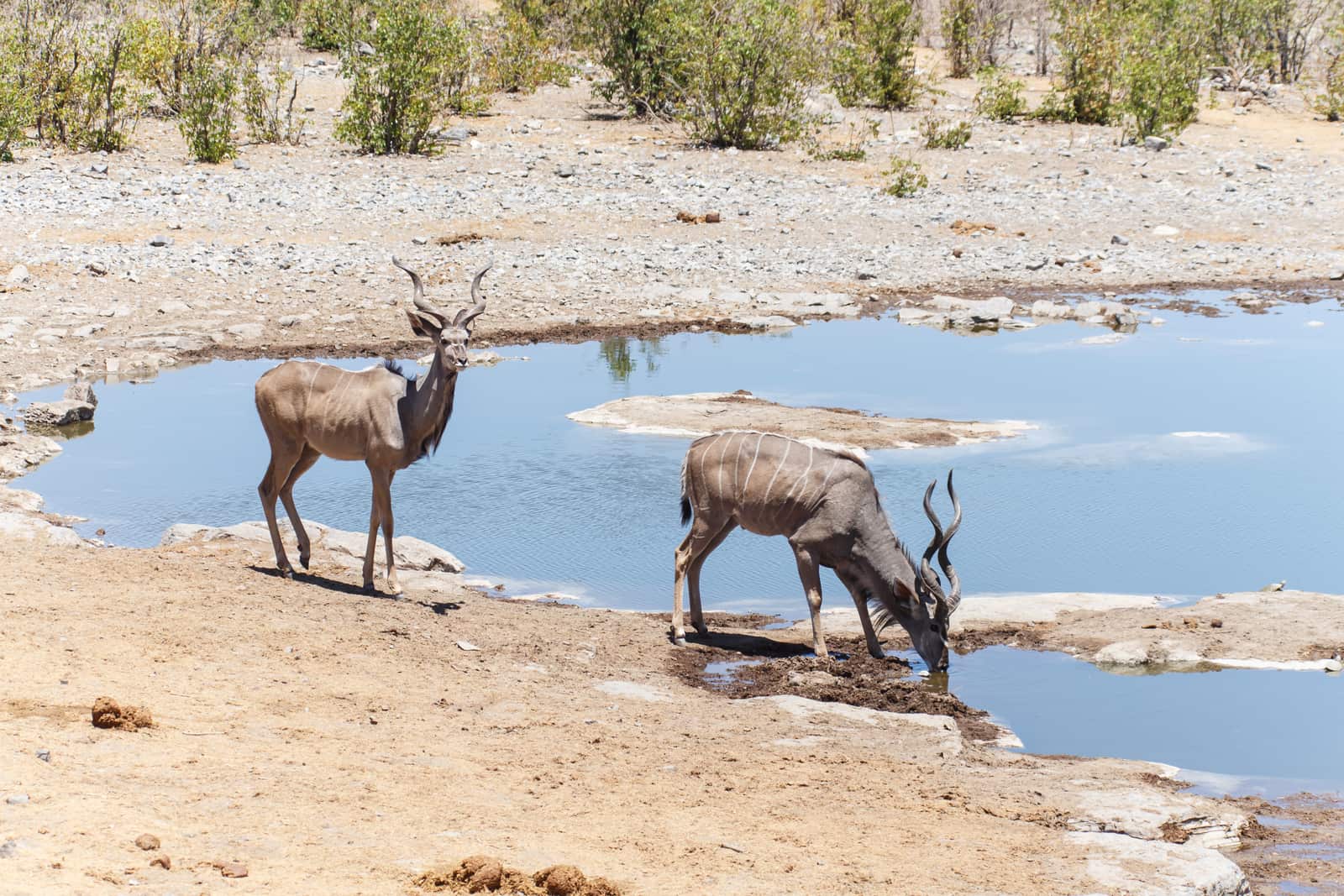
Etosha National Park in northern Namibia is the country's best-known and most visited park. It was founded as early as 1907. You drive yourself here, without a guide, on gravel roads from waterhole to waterhole. You can see elephants, lions, rhinos and leopards, but not buffalo, which do not occur in Etosha.
- founded as a game reserve
- 1907
- area of the park, depending on the source
- 22,270 or 22,935 km²
- length of the Etosha Pan
- about 130 km
- Andersson, Von Lindequist, King Nehale, Galton
- 4 gates
At the centre lies the Etosha Pan, a depression of salt, clay and lime. It is about 130 kilometres long and, according to English Wikipedia, up to 50 kilometres wide; the old version of this site said 70. The name comes from Oshiwambo and means great white place. Water only stands in it after very heavy rain, and it evaporates quickly.
You stay in the state-run camps inside the park, above all Okaukuejo, Halali and Namutoni, which you book directly with NWR. There are also Onkoshi, Dolomite and Olifantsrus. Outside the gates there are plenty of private lodges.

How the park was made and how it shrank
By around 1880 there were no elephants left in the area; hunters had wiped them out for ivory. On 22 March 1907 Governor Friedrich von Lindequist declared a vast area a game reserve, 99,526 square kilometres by the reckoning of the time. The figure was later corrected to about 80,000. The park then shrank step by step, above all when reserves for the local population were created under apartheid. Today it covers 22,270 square kilometres according to English Wikipedia, 22,935 according to German Wikipedia.
The pan was once a large lake. Geologists believe the Kunene River also flowed into the basin at one time. When it changed course, the lake slowly dried out in the arid climate, leaving salts and minerals behind. The San tell it differently. In a raid on their village all the men and boys were killed, and a mother's tears filled the lake. When the water evaporated, the salt of her tears remained.
Waterholes around the camps

Most waterholes lie along the southern edge of the pan, some fed by springs, some artificial. About 30 kilometres from Okaukuejo is Sprokieswoud, the Fairy Forest. Moringa trees grow there that look as if they were planted upside down. According to a San legend, God threw them out of his garden and they landed the wrong way up.
South of Okaukuejo are the artificial waterholes of Gemsbokvlakte and Ombika, where you often see antelope, and the natural waterhole of Olifantsbad. The name says it all: mopane grows there, and elephants love it. North of the camp is Okondeka, where zebra, springbok and wildebeest drink, and because they are there, lions often come too. At the Aus waterhole you may be lucky enough to see a rhino.

From Halali you can reach the Etosha Lookout, a point with a wide view across the pan. The nearby waterholes draw mainly antelope, zebra, wildebeest and springbok. From Namutoni the roads lead northeast to Fischer's Pan and Twee Palms. This is birdwatching country, with flamingos when the pan holds water. North of Namutoni is Tsumcor, where elephants like to gather.

Gates, times and park rules
Four gates lead into the park. From the south you come through Andersson Gate, just under 18 kilometres from Okaukuejo; from the east through Von Lindequist Gate, a little over twelve kilometres from Namutoni. King Nehale Gate is in the north and Galton Gate in the west. There is a veterinary checkpoint at Andersson Gate. You show photo ID on entry.
Park gates and camp gates open at sunrise and close at sunset; the exact times change through the year and are posted at the gate. If you are still out after the gates close, you pay a fine. Okaukuejo to Halali is about 70 kilometres and Halali to Namutoni about the same again, and with stops at waterholes each leg takes two to three hours.
The limit is 60 km/h, but if you want to see animals you drive slower. You may only get out in the fenced camps and at marked spots such as toilets and picnic sites. You stay on the roads. Overnight stays are only allowed in the camps.
When Etosha is worth it
Animals are in the park all year. From May to September it is dry and cooler, below 10 °C at night and rarely above 30 °C by day. From July to October the animals gather at the waterholes because there is nothing left to drink elsewhere. That is when you see the most. A night in a camp with a floodlit waterhole is special, and Okaukuejo has one.

Today, as of October 2026Since 1 April 2026 Etosha has been a premium park at N$ 280 per foreign adult per day, plus N$ 50 or 60 for the vehicle depending on the source. Sources also differ on whether you pay at the gate or in the camps. The west was closed to self-drivers until 2014. Galton Gate and Olifantsrus camp opened in February 2014, and Dolomite followed in 2010 or 2011. Wikipedia now puts visitor numbers at about 200,000 a year; the old site said 130,000. In August 2026 there was no fuel at any camp in Etosha; travellers filled up at the Etosha Trading Post outside Andersson Gate, in Outjo or in Tsumeb. The main road between Okaukuejo and Halali is being tarred, and in October 2026 detours ran over rough tracks. And Etosha is a malaria area: the German Foreign Office lists a high risk from September to May and reports a sharp rise in cases in 2025 and 2026.
- Time needed
- at least two nights, better three, from Okaukuejo to Namutoni
- Cost
- N$ 280 per foreign adult per day, vehicle N$ 50 or 60 (as of October 2026)
- When
- July to October for the most animals; May to September cooler and dry
Our tipFill up before the park, in Outjo, Tsumeb or at the Trading Post outside Andersson Gate, because the camps had no fuel in August 2026. And plan drives between camps so you arrive well before sunset.
Places to stay in Etosha South (Andersson Gate)
AdvertisementThe links lead to trivago. If you book through them we receive a commission; it does not influence the selection. Prices are examples for the night shown.

Tarentaal Guest Farm
10Km On D2695
- Pool
- Restaurant
- Parking
- Air conditioning
from €191per night on 23 November 2026
Check prices on trivago
Mopane Village Lodge Etosha
Road C38
- Pool
- Spa
- Breakfast
- Restaurant
from €208per night on 24 September 2027
Check prices on trivago
Etosha Village
On C38, 2km from Okaukuejo Gate
- Pool
- Breakfast
- Restaurant
- Kitchen
from €32per night on 23 November 2026
Check prices on trivagoEtosha National Park: frequently asked questions
Are there buffalo in Etosha National Park?
No. Etosha National Park has elephants, lions, rhinos and leopards, but no buffalo. So the Big Five are not complete in Etosha.
What time do the gates open in Etosha National Park?
The gates of Etosha National Park and of its camps open at sunrise and close at sunset. The exact times change through the year, and anyone arriving late pays a fine.
Can you get out of your car in Etosha National Park?
In Etosha National Park you may only get out in the fenced camps and at marked spots such as toilets and picnic sites. On the roads you stay in the vehicle.
Can you buy fuel in the Etosha camps?
In August 2026 there was no fuel at any camp in Etosha National Park. Fill up beforehand in Outjo, Tsumeb or at the Etosha Trading Post outside Andersson Gate.